Welcome to Euro Money Exchange

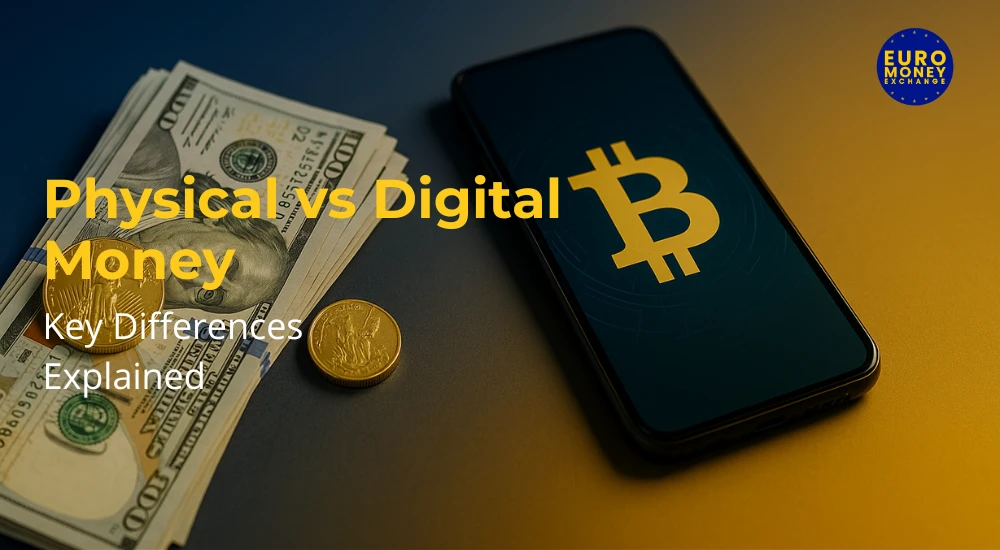
Physical vs Digital Money: Understanding the Key Differences

In today’s world, money exists in two main forms: physical and digital. Knowing how each works helps travelers, businesses, and everyday consumers make smarter financial decisions. At EuroMoney Exchange, we work with cash every day, but we also know how digital transactions impact the way people handle currency.

What Is Physical Money?

Physical money includes coins and banknotes you can hold in your hand. It is the most traditional form of currency and remains widely used for in-person transactions. Travelers often rely on cash for convenience, especially in places where cards are not accepted.

What Is Digital Money?

Digital money refers to funds stored electronically. This includes debit and credit card transactions, mobile wallets, and even cryptocurrencies. Digital money is convenient and often faster, but it depends on technology and internet access.

Key Characteristics of Physical Money

  • Tangible asset: You can hold it, store it, and use it without the need for technology.
  • Universal acceptance: Cash is accepted everywhere, from street markets to luxury stores.
  • Independence from technology: No need for internet, electricity, or apps.

Advantages of Physical Money

  • Widely recognized and trusted.
  • Ideal for small, everyday purchases.
  • Offers privacy in transactions.
  • No transaction fees.

Disadvantages of Physical Money

  • Risk of theft or loss.
  • Can be difficult to carry in large amounts.
  • Not efficient for cross-border transactions.
Travelers, for example, often rely on physical money when visiting destinations where card acceptance is limited. This is why exchanging U.S. dollars for euros before flying to France can save both time and hassle abroad.

Physical vs Digital Money: Main Differences

  • Tangibility: Physical money can be held and stored, while digital money exists only online.
  • Acceptance: Cash is accepted everywhere, but digital money may be limited in rural or offline areas.
  • Security: Cash can be stolen, while digital money faces risks of hacking or fraud.
  • Fees: Digital transactions may include hidden charges, unlike direct cash payments.

Why Cash Still Matters Today?

Despite the growth of digital payments, cash is still essential. When traveling, having physical currency ensures you can pay for transport, food, or emergencies. For example, exchanging dollars to euros before flying to France can save you time and money at your destination.

When Digital Money Is the Better Choice?

Digital money makes sense for international transfers, large purchases, or when tracking expenses. For instance, sending funds abroad using different services is covered in our guide on sending money to Mexico.

Conclusión

Both physical and digital money play important roles. Cash provides reliability and universal acceptance, while digital payments bring speed and convenience. The best approach is often to use both—carry physical money for everyday needs and rely on digital options for larger or remote transactions. At EuroMoney Exchange, we help travelers and locals access the currency they need with confidence.

FAQs

Is digital money safer than physical money?

Digital money is protected by encryption, but it depends on secure systems. Cash avoids digital fraud risks but can be physically stolen.

Can I travel without cash?

It is risky to travel with no cash. Even in major cities, some services still require physical currency.

What is the future of money?

The future likely combines both: digital currencies for speed and efficiency, and physical money for accessibility and trust. Euromoney Exchange Carousel

Leave a Reply

Your email address will not be published. Required fields are marked *